
Remember when computers first arrived in offices? That’s where we are with AI right now—except this time, the change is happening much faster. By 2025, artificial intelligence won’t be some fancy add-on. AI automation 2025 represents a fundamental shift—it’ll be as essential to running a business as electricity or the internet.
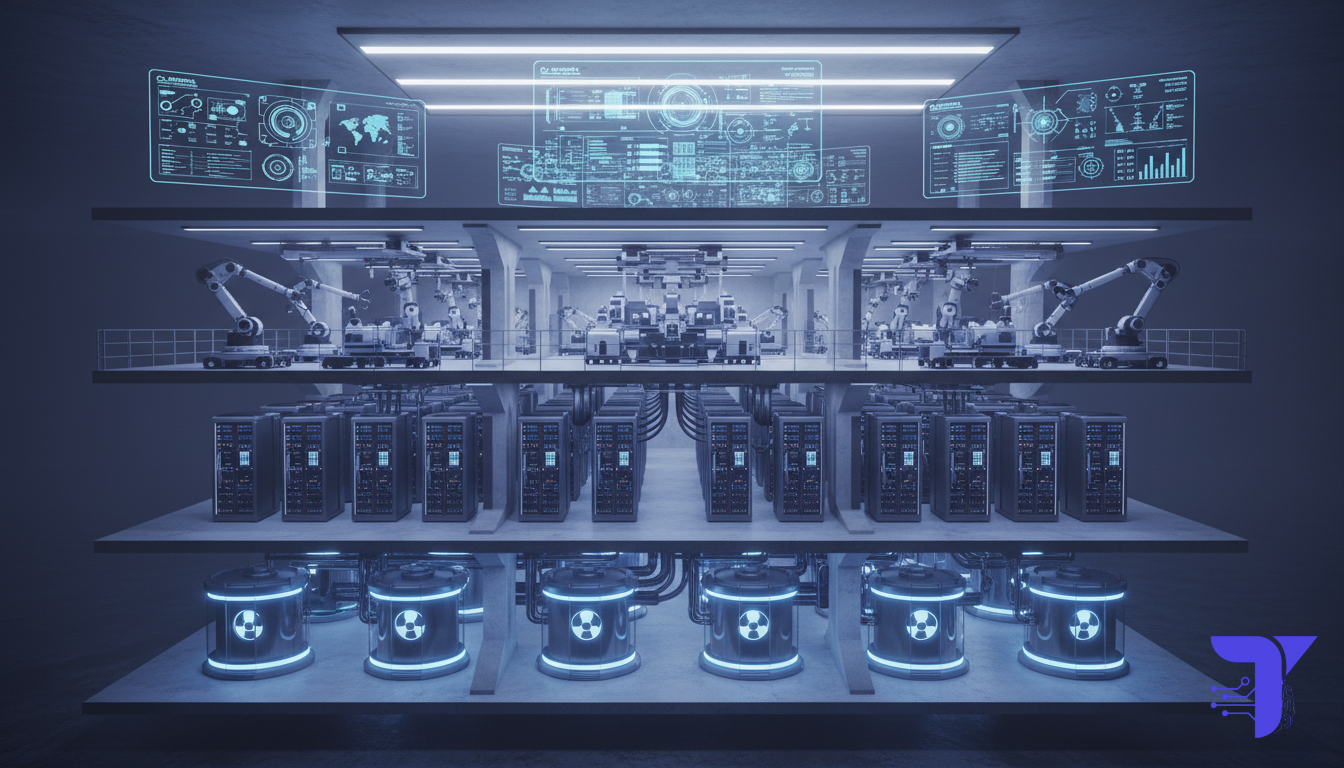
Think of it this way: AI today is building a whole new infrastructure for how companies operate. It’s not just about chatbots or fancy software anymore. We’re talking about entire systems—from the chips that power AI models to the energy grids that keep them running, all the way to robots working alongside humans on factory floors.Here’s what makes this exciting for business owners: companies using AI strategically are cutting their costs by up to 30%, according to McKinsey’s latest research. That’s not a small improvement—that’s game-changing.In this guide, I’ll walk you through the key pieces of this AI puzzle and show you exactly what it means for your business. No jargon, no hype—just practical insights you can use.Part 1: AI Automation 2025 – The Computing Power Behind It
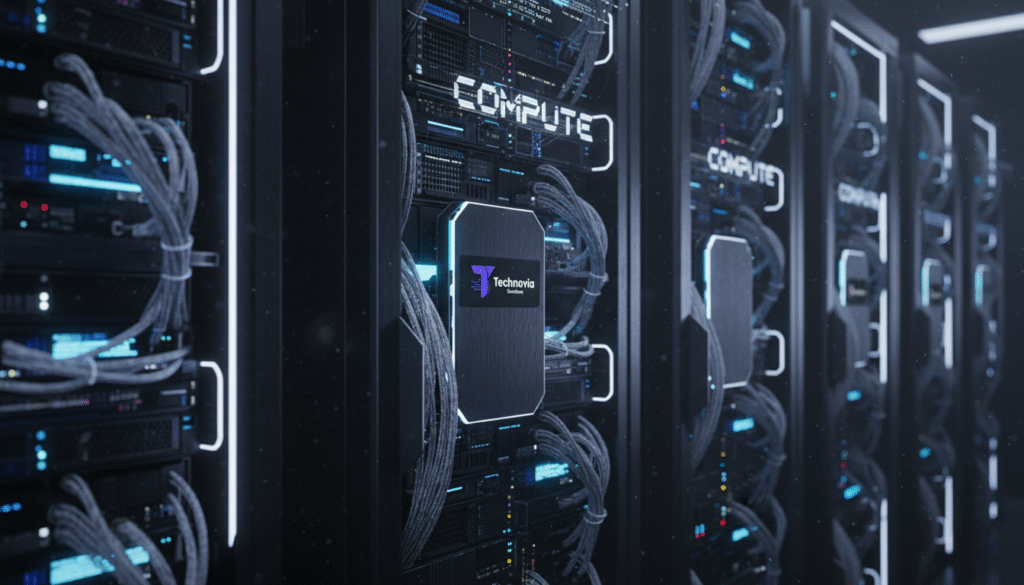
Let’s start with the basics. Every AI system needs massive computing power
to work. Think of it like horsepower in a car—the more you have, the better
it performs.
Right now, one company dominates this space: NVIDIA. Their
graphics processing units (GPUs) are the engines running everything from
ChatGPT to the AI systems automating factories. If you’ve used any AI tool
recently, there’s a good chance NVIDIA’s technology powered it.
But they’re not alone:
- AMD is challenging NVIDIA with more affordable chips.
For businesses watching their budgets, AMD’s MI300 series offers solid
performance without the premium price tag. - Super Micro Computer is building the actual servers that
house these chips. They’re creating custom setups optimized specifically
for AI workloads.
Here’s a real-world example of what this computing power enables:
Imagine a manufacturing plant with hundreds of machines. Old approach? Wait
for something to break, then fix it. New approach with AI? Sensors constantly
monitor every machine, and AI analyzes this data in real-time. The system
predicts failures before they happen—sometimes weeks in advance.
Result? Downtime drops by half.
The Reality Check:
Most companies are experimenting with AI. McKinsey found that 88% of
businesses are testing it somewhere. But here’s the catch: only 33%
actually manage to scale these experiments into full production.
What’s the difference between those who succeed and those who don’t?
The winners completely redesign their workflows around AI’s capabilities
instead of just bolting it onto existing processes.
Part 2: Data Centers Driving AI Automation 2025

If computing chips are the brain, data centers are the nervous system. These aren’t your typical server rooms—they’re massive facilities being rebuilt from the ground up to handle AI’s unique demands.
Think about it: every time you ask ChatGPT a question, massive computers in a data center somewhere are crunching through billions of calculations to generate that answer. Now multiply that by millions of users worldwide, and you start to understand why data centers matter so much.
The Big Players:
- Equinix runs a global network of interconnected facilities.
When you need AI to respond instantly—whether you’re in New York or Tokyo—
Equinix’s setup makes that possible. - Digital Realty is converting older data centers into
AI-optimized hubs. They’re upgrading cooling systems, power infrastructure,
everything needed to handle AI’s intense requirements. - Cipher Mining is doing something clever: taking old
cryptocurrency mining facilities and converting them into AI computing
centers. Why start from scratch when you can repurpose existing infrastructure?
Here’s why location matters:
For certain applications, speed is everything. Take autonomous delivery
robots navigating city streets. They can’t wait for data to travel to some
distant server and back—they need to make decisions in milliseconds. That’s
where “edge computing” comes in: processing data right where it’s needed,
close to the action.
Real-World Impact:
| Industry | What AI Does | The Benefit |
|---|---|---|
| Delivery | Powers navigation for autonomous robots | 40% faster than traditional methods |
| Manufacturing | Inspects products for defects | Catches 99.9% of quality issues |
| Retail | Manages inventory automatically | Cuts stockouts by 30% |
The Profit Problem:
Here’s something most people don’t talk about: while everyone’s excited
about AI, only 6% of companies are actually seeing meaningful profit
improvements from their AI projects. There’s still a big gap between
running experiments and making real money. This is the challenge we’re
all trying to solve in 2025.
Part 3: Energy Challenges in AI Automation 2025

Now we get to the elephant in the room: AI uses massive amounts of electricity. I mean massive. Training one large AI model can use as much power as 100 American homes consume in an entire year.
As more companies adopt AI, this is becoming a serious problem. It’s not just about cost—in some places, there literally isn’t enough power available to run new AI facilities.
New Solutions Emerging:
Some innovative companies are tackling this head-on:
- Oklo is building small nuclear reactors specifically
designed for AI data centers. These provide clean, reliable power that
doesn’t depend on weather conditions like solar and wind do. - Vistra, a traditional power company, is scrambling to
meet surging demand from AI facilities. They’re having to adapt decades-old
infrastructure for this new reality. - NextEra Energy is leading the charge in renewable
integration, building massive solar and wind farms to power the AI
revolution sustainably. - Fluence is creating smart power grids with battery
storage. Their systems can cut power outages by 40%—critical when you’re
running AI systems that can’t afford to go down.
Why This Matters for Your Business:
Imagine investing in warehouse automation—robots, AI systems, the works.
Everything’s running smoothly, productivity is up. Then a power outage
hits, and your entire operation stops. All those expensive robots just
sit there, useless.
This is why energy planning has to be part of any AI strategy. Before
you invest in AI automation, you need to know: Can your facility handle
the power requirements? Do you have backup systems? What happens during
peak usage times?
Part 4: Robotics and AI Automation 2025
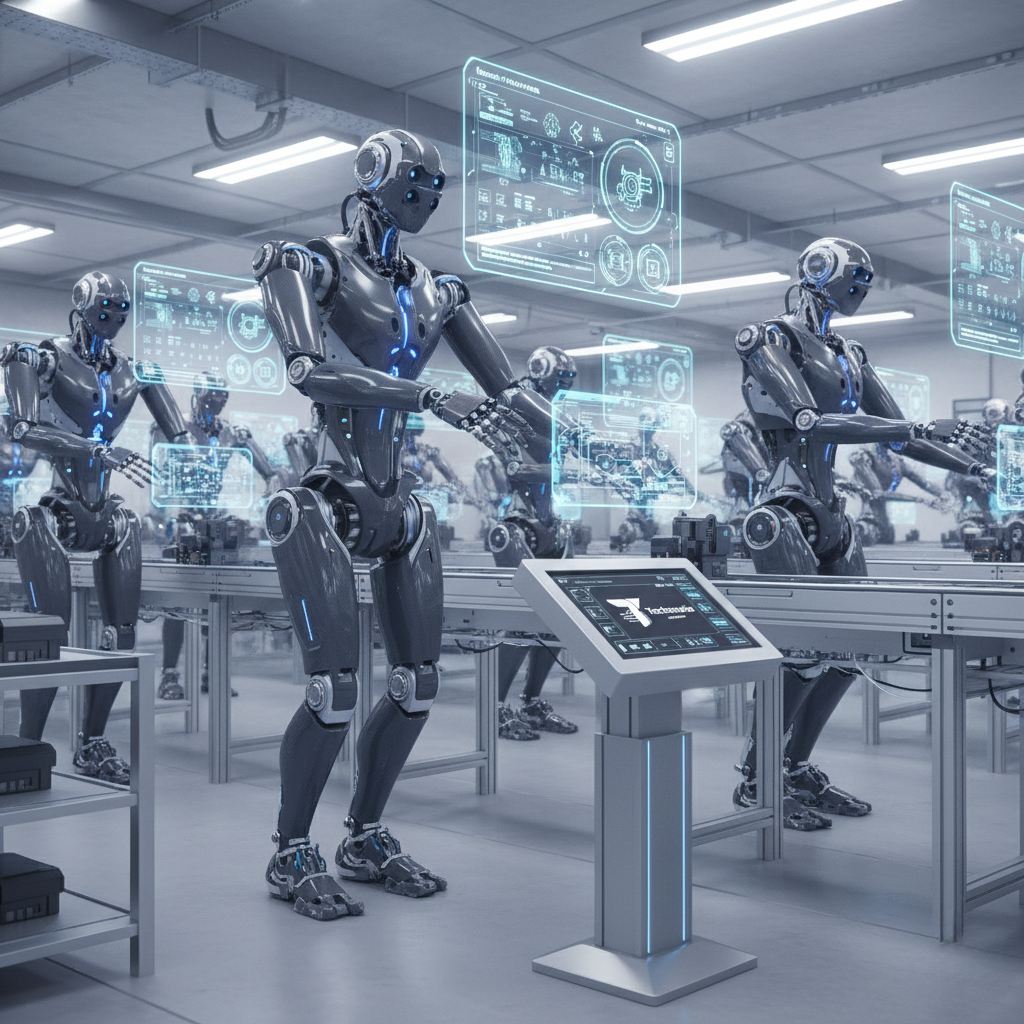
Here’s where things get really interesting: AI moving from software into
physical robots. We’re not talking about the clunky industrial robots of
the past. These new machines can learn, adapt, and work alongside humans.
What’s Happening Now:
- Tesla’s Optimus robot is grabbing headlines. It uses
the same AI technology that powers Tesla’s self-driving cars, but applied
to a humanoid robot. Target applications? Manufacturing and warehouse
logistics. - iRobot isn’t just making vacuum cleaners anymore. They’re
moving into industrial cleaning and inspection systems for businesses. - UiPath focuses on “digital robots”—software that automates
repetitive computer tasks. Think data entry, report generation, email
responses—boring stuff humans hate doing. - Serve Robotics is putting delivery robots on city streets.
These use edge computing to navigate complex urban environments in real-time.
The Teamwork Approach:
Here’s what successful companies are learning: AI doesn’t replace humans—
it works with them. The best results come from hybrid teams where:
How Hybrid Teams Work:
AI handles the stuff it’s good at: Processing huge
amounts of data, spotting patterns, making predictions based on historical
information.
Humans focus on what they do best: Creative thinking,
strategic decisions, understanding emotional context, and making ethical
judgments.
Companies using this model are seeing productivity double—yes, double—
while employees actually report being happier because they’re not stuck
doing mindless tasks anymore.
The Multi-Agent Revolution:
Research shows 51% of organizations will be running “multi-agent systems”
by the end of 2025. What does that mean in plain English? Instead of one
AI doing one job, you have multiple AI systems working together to handle
complex projects. It’s like moving from a solo worker to a coordinated team.
Part 5: Control Systems for AI Automation 2025

With all these AI systems working together, someone needs to orchestrate
them. That’s where the control layer comes in—think of it as the conductor
of an orchestra.
The Main Platforms:
- Microsoft Azure + OpenAI have created an integrated
system. Microsoft’s cloud infrastructure combined with OpenAI’s advanced
models (like ChatGPT) gives businesses everything they need to deploy
AI at scale. - Palantir specializes in critical industries—defense,
healthcare, manufacturing. They’re building operating systems that blend
AI decision-making with human expertise. - Google Cloud’s Vertex AI provides a complete platform
for building, deploying, and managing AI models with built-in governance
and security.
The Human Element:
The smartest companies aren’t thinking about AI as a tool they control.
They’re thinking about it as a partner. This requires:
- Real-time monitoring: Dashboards that show what AI is
doing and let humans step in when needed. - Explainability: AI systems that can explain their
reasoning in terms humans understand. This builds trust and makes
auditing possible. - Feedback loops: Humans correct AI mistakes, and AI
highlights insights humans might miss. Both get smarter over time.
The Workforce Reality:
Let’s be honest about something: yes, AI will eliminate some jobs.
McKinsey estimates 30% of organizations expect to reduce support staff
due to AI automation. That’s the hard truth.
But here’s the flip side: the best-performing companies aren’t just
cutting jobs. They’re creating entirely new product categories and revenue
streams using AI. About 23% are testing these new models, and 10% have
already scaled them successfully.
Part 6: Why AI Automation 2025 Demands Action Now

Here’s the bottom line: AI isn’t coming—it’s already here. The infrastructure is being built right now, and companies that wait too long will find themselves at a massive disadvantage.
Think of it like the internet in the 1990s. Some companies said “we’ll wait and see.” Others jumped in early. Who won? The early adopters completely reshaped their industries while the waiters struggled to catch up.
Your Roadmap for 2025:
Phase 1: First Quarter – Get Your Bearings
- Start by looking at your current operations. Where are the biggest bottlenecks? Where do you waste the most time and money?
- Pick one or two areas for a pilot project. Good candidates: customer service, R&D, quality control—anywhere you can easily measure results.
- Establish baseline numbers. What does it cost now? How long does it take? What’s the error rate? You need these numbers to prove ROI later.
- Budget for infrastructure. This isn’t just software costs—you might need upgraded internet, more power capacity, better computers.
Phase 2: Mid-Year – Scale What Works
- Take your successful pilots and expand them. Deploy multi-agent systems in production environments.
- Integrate with your existing systems. Your ERP, CRM, whatever you’re already using—the AI needs to work with it, not replace it.
- Train your people. This is crucial. Your employees need to understand how to work alongside AI effectively.
- Set up governance. Create clear rules for how AI should be used, what decisions it can make alone, and when humans need to be involved.
Phase 3: 2026 and Beyond – Transform Completely
- Now you’re ready for bigger changes. Redesign entire business processes around what AI makes possible.
- Consider building proprietary AI models specific to your industry. This becomes your competitive advantage.
- Invest in edge computing if you need real-time decisions. Manufacturing, logistics, and retail especially benefit here.
- Look for new revenue opportunities. Can you turn your AI capabilities into services you sell to others?
What You Need to Succeed:
Based on what’s working across industries, here are the critical factors:
| Factor | Why It Matters | The Impact |
|---|---|---|
| Clean Data | Your AI is only as good as the data you feed it | Companies with organized data see 80% better results |
| Change Management | If employees don’t buy in, your AI project will fail | Good training = 3x higher adoption rates |
| Infrastructure | Don’t skimp on computing power and energy | Eliminates bottlenecks that kill projects |
| Governance | Clear rules for ethics, security, compliance | Protects from regulatory problems |
A Tip for Your Website:
If you’re creating content about AI (which you should be—it shows expertise), use something called structured data markup. It’s basically a way to help search engines understand your content better. Google increasingly rewards this with better visibility in search results. Check out Schema.org for the technical details.
Wrapping Up: The Revolution Is Now
We’re living through a massive shift—probably the biggest technological change since the internet itself. AI infrastructure in 2025 isn’t science fiction. It’s operational reality.
From NVIDIA’s powerful chips to nuclear-powered data centers, from warehouse robots to enterprise control systems—this is a complete ecosystem. And it requires serious, strategic investment.
Companies ignoring this will struggle. Those embracing it systematically— starting with pilots, measuring actual business impact, scaling what works, and building the right infrastructure—these are the ones that will dominate their industries for the next decade.
Ready to Build Your AI Strategy?
At Technovia Solutions, we help businesses navigate exactly this kind of transformation. We’re not selling hype—we’re talking about practical implementation. From assessing your current infrastructure to hands-on deployment, we guide you through every phase.
Your automation future starts today. Track the right metrics, invest in the right infrastructure, and build your team’s skills for an AI-driven world. The 2025 industrial revolution isn’t waiting for anyone. Are you ready?
Sources & Further Reading:
- McKinsey & Company: Latest AI insights and research
- NVIDIA: AI and data science resources
- Industry analysis from leading tech experts
- Public company reports (NVIDIA, AMD, Microsoft, Tesla)